Deck Builders in Ocala, FL: Installation, Replacement and Repair
New decks, full replacements, and repairs to the framing underneath. Pressure-treated, composite, and PVC, built to the Florida Building Code and permitted on every job that needs one.

A deck in Florida has a harder life than most
Ocala gets roughly 50 inches of rain a year, most of it in summer afternoon storms, and the boards rarely dry out between them. Add subterranean termites, sandy soil that shifts under footings, and sun that pushes a dark deck surface well past comfortable, and you get decks that look fine at five years and feel spongy at eight.
Most of the deck failures we get called out for don't start with the boards. They start where water sits: a ledger bolted to the house with no flashing, posts buried straight in the dirt, joist hangers eaten up by treated lumber they were never rated for. The surface is what people see. The structure decides how long it lasts.
We're a licensed Florida building contractor (CBC1268994), so we handle the whole job: design, permit, footings, framing, decking, stairs, railings, and inspections. Whether you want a new deck off the back slider, a replacement for one that's past saving, or repairs to the framing under your boards, it's one company and one written scope.

Deck installation, replacement and repair services
Any of these can be pressure-treated, composite, or PVC, and most deck projects combine two or three of them.
New deck installation
Ground-level platforms off a slider, raised decks off a back door, and multi-level decks that step down to the yard. We design to your lot, pull the permit, and build it.
Deck replacement
When the framing is too far gone to save, we tear out the old deck, haul it off, and rebuild on new footings. Often the same footprint, sometimes bigger now that you know how you actually use it.
Deck repair
Rotted joists, failing ledgers, sinking posts, soft boards, and loose railings. We open it up, find where the water's getting in, and fix the structure, not just the surface.
Composite and PVC decking
Low-maintenance boards from the major composite and PVC lines, installed with hidden fasteners and the joist spacing and board gaps the manufacturer calls for, so the warranty holds up.
Deck stairs and railings
New stairs, rebuilt stairs, and guards wherever the deck is high enough to need them. Wood, composite, and aluminum railing systems.
Elevated and second-story decks
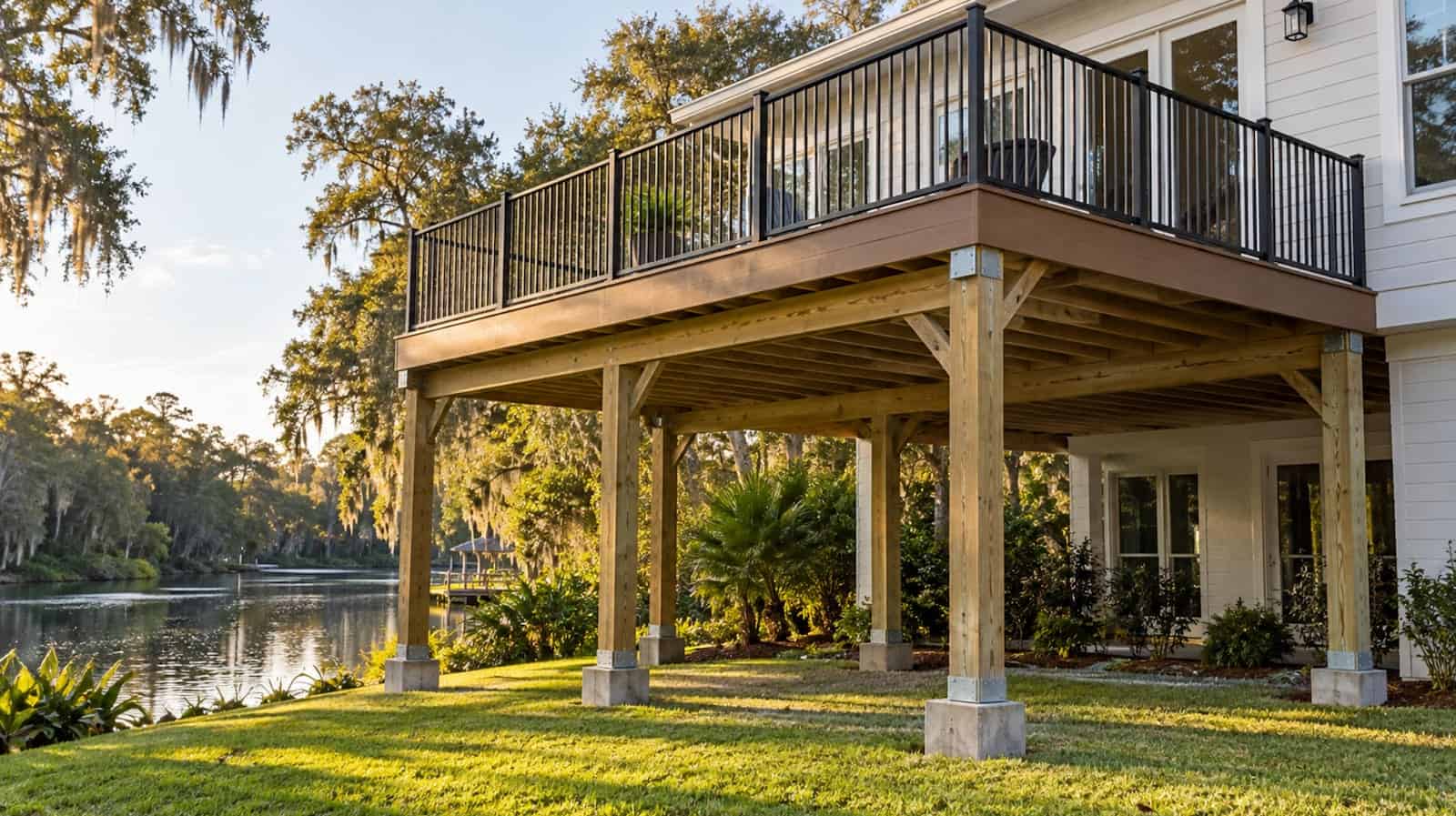
Decks on sloped lots, waterfront lots, and off second-floor doors. Taller decks carry more load and catch more wind, so they get heavier posts, engineered beams, and bracing.
Wood vs composite vs PVC decking in Florida
There's no single right answer. It comes down to budget, how long you plan to stay in the house, and how much upkeep you're willing to do every couple of years.
| Pressure-treated pine | Composite | PVC | |
|---|---|---|---|
| Upfront cost | Lowest | Middle | Highest |
| Upkeep | Clean and seal or stain every 2 to 3 years | Wash once or twice a year | Wash once or twice a year |
| Typical life here | About 10 to 15 years with upkeep | 25 years or more, with long manufacturer warranties | 25 years or more, with long manufacturer warranties |
| Rain and humidity | Soaks up water and has to dry out between storms | Capped boards shed water | Doesn't absorb water at all |
| Termites | Treated to resist them, still vulnerable at cuts and in soil | Boards won't feed them | Boards won't feed them |
| Florida weak spot | Rot, splinters, and checking in the sun | Mildew on shaded boards that don't get washed | Moves more with heat, so the gaps have to be right |
The framing is still wood
One thing doesn't change with the boards: the framing under a composite or PVC deck is pressure-treated lumber. A 25-year board on a frame that rots out in 12 doesn't buy you much. On composite builds we use ground-contact rated lumber for posts and beams, joist tape on the tops of joists and beams to shed water, and hot-dip galvanized or stainless hardware rated for treated lumber.
Think about heat
In full Florida sun, dark composite boards can get hot enough that you'll want shoes on in July. If your deck faces west or south with no shade, go with a lighter color and ask to see a sample that's been sitting outside, not one from a showroom.
When wood is the right call
If you're selling in a few years, need a lot of square footage on a tight budget, or just like real wood, pressure-treated pine is a solid deck when it's built right and sealed on schedule.

Deck repair in Ocala: fix it or replace it?
A lot of decks we look at are worth saving. Some aren't. Here's what we check and how we make the call.
Signs your deck needs repair
- Soft spots, or boards that flex when you step on them
- Dark staining or crumbling wood where the deck meets the house (the ledger)
- Posts sitting right in the soil, or posts that are soft at the bottom
- A railing that moves when you lean on it
- The whole deck sways or bounces when people walk across it
- Rusted, bent, or missing joist hangers and bolts
- Mud tubes on posts or framing, a sign of subterranean termites


When repair makes sense
If the damage is limited to a few joists, a section of boards, a post or two, or the stairs, repair is usually the better buy. We sister or replace damaged joists, move posts onto proper footings, rebuild stairs, and replace the boards over the repaired area.
When replacement makes more sense
If the ledger is rotted, the footings are failing across the deck, or more than about a third of the framing is bad, you're paying to rebuild most of the deck anyway, one piece at a time. At that point a new deck on new footings usually costs less over the next 15 years, and it comes with a permit and a final inspection that a patch job doesn't.
If rot has spread past the deck into the house, like the rim joist or the wall framing behind the ledger, that's a structural repair to the home itself. We handle that too. See our structural repairs page.
One honest note: we're set up for structural deck repair and full replacements. If you only need three or four boards swapped and the framing underneath is solid, a handyman will usually be the cheaper call, and we'll tell you so.
How much does a deck cost in Ocala?
These are planning ranges based on current Marion County material and labor costs for permitted work by a licensed contractor. They aren't quotes, and they aren't averages of our past jobs. Your number depends on size, height, materials, and the site, and you'll get a written price after we see it.
Deck repair
Joist and post replacement, ledger repair, stair rebuilds, and new boards over the repaired area. A full ledger rebuild sits at the top of the range.
Pressure-treated deck
Installed, with footings, framing, decking, and basic stairs. A 300 sq ft deck runs about $10,500 to $16,500.
Composite or PVC deck
Installed on pressure-treated framing with hidden fasteners. A 300 sq ft deck runs about $16,500 to $28,500.
Elevated or second-story deck
Taller posts, engineered beams, bracing, and longer stair runs. Engineering, when the permit requires it, is extra.
What moves the price
Height is the big one. Once a deck is high enough to need guards, railing can add $40 to $100 per linear foot depending on the system. Stairs cost more the more steps there are. Tearing out an old deck usually runs $5 to $15 per sq ft. Attaching to a block home takes masonry anchors instead of lag screws. Sloped lots, tight access to the backyard, and engineered drawings for taller decks all add to the total.
Board choice matters less than people expect, because the footings, framing, labor, and permit stay about the same whichever board you pick. That's why the gap between a wood deck and a composite deck is smaller on the final bill than it looks at the lumber yard.
Deck permits in Marion, Sumter and Lake County
Under Florida Building Code Section 105.1, building, altering, or repairing a structure takes a permit unless the work is specifically exempt, and the exemptions that cover decks are narrow. We pull the permit on every new deck, every replacement, and every structural repair. It's built into our price, and it means an inspector checks the footings and framing before the boards cover them up.
The deck itself is designed to the residential code's deck section (R507), which sets footing size, joist spans, how the ledger attaches to the house, and when guards are required.
Marion County (unincorporated)
Marion County Building Safety handles most addresses outside Ocala city limits, which includes plenty of homes with an Ocala mailing address. The county's permitting FAQ exempts only ordinary minor non-structural repairs, so a new deck, a replacement, or any work on joists, posts, or the ledger needs a permit.
Marion County Building Safety, 352-438-2400
City of Ocala
Inside city limits, the City of Ocala Building Division issues the permit through its eTrakit portal. First review typically takes about 10 business days on a complete submittal and about 5 on a resubmittal. Homes in one of Ocala's historic districts may also need historic preservation review for exterior work.
City of Ocala Building Division, 352-629-8421
Sumter County and The Villages
Sumter County Building Services covers unincorporated Sumter and the Sumter County side of The Villages. Wildwood handles its own permits. In The Villages, Architectural Review approval is a separate step we run alongside the permit, and because The Villages crosses into Lake and Marion counties, we confirm the jurisdiction for your address first.
Lake County
Lake County Building Services covers unincorporated Lake. Its deck exemptions are narrow: a small freestanding deck under 30 inches high and 120 sq ft, built by the owner on their own home, or replacing just the walking surface of a legally permitted deck at the same size or smaller. Anything beyond that needs a permit. Lady Lake and Leesburg run their own building departments.
What gets inspected
Inspection stages vary by jurisdiction, but a deck permit usually gets checked at the footings before posts or concrete go in, at framing before the boards cover it, and at final once the stairs and railings are done. We schedule each one and meet the inspector on site.
How a deck project works with us
Free estimate
Start with a virtual estimate through our form, or have us out to the house. For repairs, we'll want to get under the deck and look at the framing.
Design and written scope
We lay out size, height, stairs, and materials, then put it in writing: board line and color, railing system, hardware, footings, and what's not included.
Permit
We prepare the drawings, submit to your county or city, and answer any plan review comments. In The Villages, we run Architectural Review alongside it.
Build and inspections
Footings, framing, decking, stairs, and railings, with an inspection at each stage the permit calls for. Most decks take about a week of build time once the permit's issued.
Final walkthrough
We walk the deck with you, close out the permit, and give you care instructions for the material you picked.

How to choose a deck contractor in Ocala
Plenty of people build decks around here. Fewer build them to code, pull permits, and stand behind the framing. Before you sign with anyone, us included, check these:
- A state license you can look up. Search the company or owner on the Florida DBPR license portal. A deck carries people, so the framing deserves the same scrutiny as anything inside your house. Ours is CBC1268994. Here's more on why licensing matters.
- They pull the permit, not you. If a contractor asks you to get the permit in your name, the responsibility for the work shifts to you.
- Proof of insurance. Ask for general liability and workers' comp certificates sent straight from the insurance agent.
- The ledger detail in writing. Ask how they'll attach the deck to your house and how they'll flash it. On a block home that means masonry anchors. On frame or stucco it means flashing behind the finish. "Nails" or "we'll figure it out" is the wrong answer.
- Footings and post bases. Ask how deep the footings go and whether posts sit on concrete with standoff bases or go in the ground. Both can meet code. You should know which one you're getting.
- Hardware rated for treated lumber. Modern treated lumber corrodes plain steel. Hangers and fasteners should be hot-dip galvanized or stainless.
- A written scope with the actual product. Board brand and color, railing system, stair count, and exclusions. A one-line "build 12x16 deck" quote leaves too much open.

Deck builders serving Ocala, The Villages and nearby towns
We're based in Ocala and build decks across Marion, Sumter, and Lake counties, plus nearby parts of Citrus County.
Ocala
Older homes in NE Ocala and around downtown often sit on raised foundations, so a back-door deck ends up two or three feet off the ground and needs stairs and guards. Newer block homes in SW Ocala and along SR 200 are mostly slab-on-grade, which suits a low deck off the slider. Attaching to block takes masonry anchors, and that's where a lot of DIY ledgers go wrong.
Remodeling in OcalaDunnellon and Citrus Springs
Lots along the Rainbow and Withlacoochee rivers slope toward the water, which is where elevated and multi-level decks come in. Waterfront and low-lying lots can also bring floodplain review into the permit. In Citrus Springs, most homes are newer slab builds where a ground-level deck makes the most sense.
Remodeling in DunnellonThe Villages
Most Villages homes came with a lanai, and a lot of owners are better served by expanding or enclosing it than by adding a deck. When a deck is the right fit, it goes through Architectural Review before the permit. We'll tell you up front which way we'd go and why.
Remodeling in The VillagesSummerfield and Belleview
Bigger lots south of Ocala leave room for larger decks, multi-level layouts, and wood or composite decks built around above-ground pools. Rural properties here can sit outside any HOA, which keeps material and color choices wide open.
Summerfield and BelleviewLady Lake and Leesburg
Both cities run their own building departments, separate from Lake County, so the permit goes to the city. Lakefront homes on Lake Harris and Lake Griffin often slope down to the water, which calls for an elevated or stepped deck.
Lady Lake and LeesburgWildwood
Wildwood handles its own permits, separate from Sumter County. Newer subdivisions can have HOA rules on deck materials, colors, and placement, so we check those before we price boards.
Remodeling in WildwoodRecent deck work in Ocala


Licensed, insured, and permitted on every deck
Florida Legacy Construction is a state-certified building contractor. Every new deck, replacement, and structural repair we build is permitted and inspected. You can verify our license on the Florida DBPR portal.
Deck installation and repair questions
How much does it cost to build a deck in Ocala?
Planning ranges for permitted work run about $35 to $55 per square foot for a pressure-treated deck and $55 to $95 per square foot for composite or PVC, installed. Elevated and second-story decks run about $75 to $120 per square foot. A 300 square foot pressure-treated deck lands around $10,500 to $16,500. Height, railings, stairs, tearing out an old deck, and site access move the number most.
Do I need a permit to build a deck in Marion County?
In almost every case, yes. Marion County's permit exemptions only cover ordinary minor non-structural repairs, so new decks, replacements, and repairs to joists, posts, or the ledger need a permit. Inside Ocala city limits, the City of Ocala issues it instead. We pull the permit on every deck job and it's included in our price.
Is composite decking worth it in Florida?
It usually is if you plan to stay 8 to 10 years or longer. Composite costs more up front, but it skips the sealing and staining wood needs every 2 to 3 years in this climate, and the boards won't rot or feed termites. The tradeoff is heat. Dark composite boards get hot in full sun, so pick a lighter color for a deck that faces west or south.
How long does a deck last in Florida?
A well-built pressure-treated deck typically lasts about 10 to 15 years here with regular sealing. Composite and PVC boards commonly carry warranties of 25 years or more. Either way, the framing is usually what fails first, which is why ledger flashing, joist tape, rated hardware, and proper footings matter more than the boards.
Can my deck be repaired, or does it need to be replaced?
If the damage is limited to a few joists, a post or two, the stairs, or a section of boards, repair usually makes sense. If the ledger is rotted, the footings are failing, or more than about a third of the framing is bad, replacement usually costs less over time. We get under the deck and look at the framing before we recommend either one.
How long does it take to build a deck?
Most residential decks take about a week of build time once the permit is issued, sometimes less for a simple ground-level deck. Permitting comes first and typically takes one to three weeks, depending on the jurisdiction and whether plan review sends back comments. Summer afternoon storms can stretch the build schedule.
Do you build decks in The Villages?
Yes, though a lot of Villages homes are better served by expanding or enclosing the existing lanai. When a deck is the right fit, it needs Architectural Review approval in addition to the building permit, and we handle both. We also confirm whether your address falls under Sumter, Lake, or Marion County before we apply.
Do you resurface concrete pool decks?
No. Concrete and paver pool deck resurfacing is a different trade, and we don't offer it. We do build wood and composite decks, including decks built around above-ground pools.
Can you add a roof or screen enclosure to my deck?
Yes, but it's a different project than a deck. A roof adds weight and wind uplift that the footings and framing have to be designed for, and enclosing it turns it into a lanai or room addition. We price those through our home additions work.
When is the best time of year to build a deck in Florida?
October through May is the easiest stretch. It's drier, so footings and inspections stay on schedule and new lumber has a chance to dry before it's sealed. We build year-round, but summer jobs get planned around the afternoon storms.
Get a free deck estimate
Tell us what you have in mind, or what's going wrong with the deck you've got. Virtual estimates are free.
Rather talk it through? Call (352) 356-5036.