Financing a new build in Ocala and The Villages
Building a house, an ADU, or a large addition is paid for differently than a kitchen remodel. Here is how construction loans actually work, what a lender will ask you for, and who to call locally.
Start with which kind of project you have
Almost every financing question we get comes down to one fork in the road. Remodels and new builds use completely different products, and applying for the wrong one wastes a few weeks.
Remodeling an existing home
Kitchens, bathrooms, aging-in-place work, flooring, and most single-room projects. These are usually funded with a home improvement loan, a home equity product, or cash, and the money goes to you as a lump sum.
See remodeling financing optionsBuilding something new
A custom home on your lot, a detached ADU, a whole-home renovation, or a large multi-room addition. These are funded with a construction loan that pays out in stages as the work is completed. That is this page.
Keep readingWhat a construction loan is
A construction loan is a short-term loan that funds a house while it is being built, then either converts to or gets replaced by a regular mortgage once the home is finished.
The part that surprises most first-time builders is that you do not receive the money up front. The lender holds the funds and releases them in stages, called draws, as each phase of the build is completed and inspected. That protects the lender, and it protects you, because nobody gets paid for work that has not happened yet.
During construction you typically make interest payments only on the amount that has actually been drawn, not on the full loan. So the payment in month two, when only the slab is poured, is much smaller than the payment in month ten. Once the certificate of occupancy is issued, the loan moves to permanent financing and you start making normal principal and interest payments.
One-time close
Construction financing and the permanent mortgage are set up in a single closing. You qualify once, sign once, and pay one set of closing costs.
Fewer moving parts and less paperwork at the back end, which matters when a build runs long.
Two-time close
You close on the construction loan first, then close again on the permanent mortgage when the house is done. Two closings, two sets of costs.
More flexibility on the permanent side, since that loan is set up closer to move-in.
Which one is right
That depends on your credit profile, your down payment, how long the build will take, and where you think rates are headed.
This is a lender conversation, not a builder conversation. We are happy to sit in on it, but we do not make that call for you.
Who we send new-build clients to
We are a licensed building contractor, not a lender or a mortgage broker. We do not originate loans, we do not make credit decisions, and we do not get to see your financials. What we can do is point you at someone local who does construction lending every day.

- Phone
- 352-304-3747
- lori.meaney@primelending.com
- Office
- 3200 SW 34th Avenue, Bldg 100, Ste 102, Ocala, FL 34474
- Loan types
- New construction, VA, FHA, conventional, jumbo, renovation, USDA
How the money actually reaches the job
This is the part builders and lenders talk about constantly and homeowners almost never hear explained. Understanding it will save you a lot of anxiety around month four.
The budget gets broken into line items
Before closing, the lender takes our construction contract and budget and turns it into a schedule of values: site work, foundation, framing, roof, mechanicals, drywall, finishes, and so on. That schedule is what every future payment is measured against.
We complete a phase
Work proceeds normally. Our crews and subcontractors do the phase, county inspections happen on the building department's schedule, and we document what is finished.
We submit a draw request
We send the lender a request covering the completed line items, with photos and any supporting invoices. On most loans the lender sends an inspector to the site to confirm the percentage of completion independently.
The lender funds the draw
Once the inspection clears, the lender releases that portion of the funds. Lien releases from suppliers and subcontractors are typically collected as part of this step, which is what keeps liens off your property.
Repeat until the home is finished
A typical custom home runs through several draws from foundation to final. The last draw is usually released at or near the certificate of occupancy.
The loan converts to permanent financing
With a one-time close, this happens automatically. With a two-time close, you close a second time on the permanent mortgage. Either way, interest-only construction payments end and your regular mortgage payment begins.
What that looks like on the ground
The same four milestones on an actual build, and what the inspector is checking at each one.
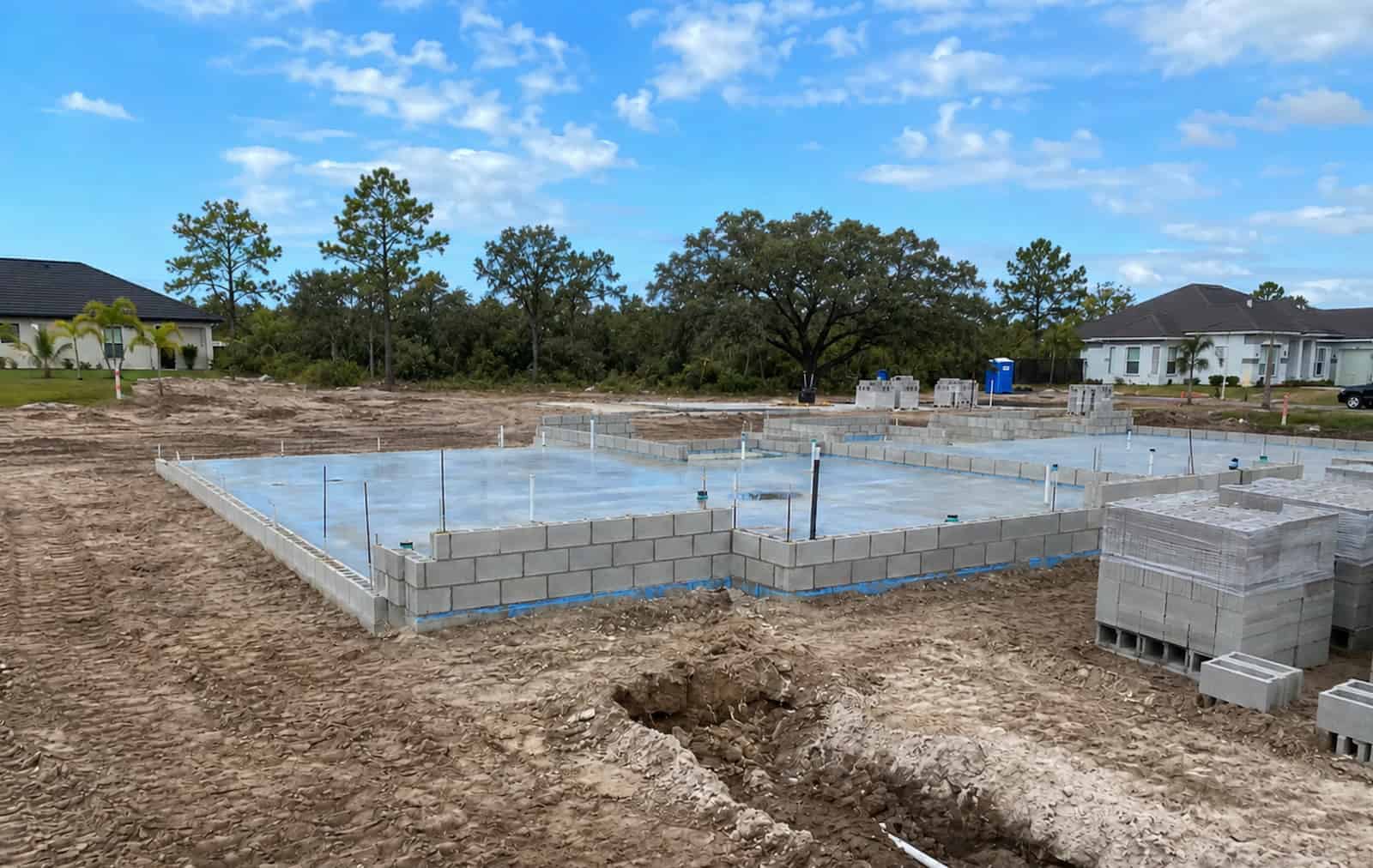
Foundation
Site work, footers, and slab. The first substantial draw generally comes once this is complete and the county has inspected it.

Framing and dry-in
Walls up, roof on, windows in. The lender's inspector is confirming the structure is standing and weather-tight before this one funds.

Interior finishes
Drywall, trim, cabinets, and mechanicals trimmed out. This stretch usually spans more than one draw, because it covers the most trades.

Complete
Final inspection and certificate of occupancy. The last draw is released here, and the loan converts to permanent financing.
What a construction lender will ask you for
Every lender is different, but almost all of them want to see the same core package. Having these ready is the single biggest thing you can do to keep the process moving.
- The lotEither owned outright, under contract, or included in the loan. Ownership status changes how the loan is structured, so tell the lender early.
- Plans and specificationsA complete permit-ready plan set with engineering, not a sketch. The lender's appraiser values the finished home from these.
- A signed construction contractBetween you and a licensed contractor, with a defined scope and price. We provide this.
- A detailed line-item budgetBroken down by phase and trade. This becomes the draw schedule.
- Contractor license and insuranceWe supply our Florida license CBC1268994 along with current general liability and workers' compensation certificates.
- Your financial documentsIncome, assets, tax returns, and credit. Exactly what the lender asks for, since requirements vary by loan type.
Projects that use construction financing
Custom homes
Building on a lot you own or are buying, in Marion, Sumter, or Lake County.
Detached ADUs
A separate dwelling unit on your property, where county and city zoning allow it.
Large additions and in-law suites
Multi-room wings and attached suites that run past what an unsecured home improvement loan will cover.
Whole-home renovations
Down-to-studs projects. These often fit a renovation loan product better than a ground-up construction loan, so ask about both.
How financing lines up with the build calendar
On a custom home we plan for roughly 3 to 5 months of design, engineering, selections, and permitting, then approximately 9 to 12 months from construction start to certificate of occupancy. Your loan has to cover that full construction window, which is why lenders set a term on the construction phase and why an early conversation matters.
The practical sequence: talk to a lender before you finalize plans, so the budget you design to is the budget you can actually finance. Plans get drawn and engineered. We produce the contract and line-item budget. The lender underwrites and appraises. You close. Then permits are pulled and site work starts.
Homeowners who talk to a lender after the plans are already engineered often end up redrawing them. That is an expensive way to find out what your budget is.
Construction loan questions we get
Do you offer in-house or builder financing?
No. Florida Legacy Construction is a licensed building contractor, not a lender or a mortgage broker. We do not originate loans, set rates, or make credit decisions. We provide the construction documents your lender needs and we work with whatever lender you choose.
What is the difference between a one-time close and a two-time close construction loan?
A one-time close combines the construction loan and the permanent mortgage into a single closing, so you qualify once and pay one set of closing costs. A two-time close means you close on the construction loan first and close again on the permanent mortgage after the home is finished, which means two closings and two sets of costs but more flexibility on the permanent loan. Which one fits depends on your situation, and your lender is the right person to walk you through it.
Can I use my own lender instead of the one you mention?
Yes, and plenty of clients do. We are not tied to any lender and we do not require you to use a particular one. We will provide the same construction contract, line-item budget, license and insurance documentation, and draw requests to any lender you bring.
How does the lender pay for the work as the house gets built?
Through a draw schedule. The lender holds the loan funds and releases them in stages as phases of the build are completed. We submit a draw request with documentation, the lender usually sends an inspector to verify the percentage of completion, and then that portion of the money is released. Lien releases from subcontractors and suppliers are typically collected at the same time.
Do I need to own the lot before I apply?
Not necessarily. Some construction loans include the lot purchase in the financing, and some require the land to be owned outright or carried as equity. Whether you own it, have it under contract, or are still shopping, tell the lender at the first conversation, because it changes how the loan is structured and how much you need to bring to closing.
Can a construction loan cover an ADU or a large addition instead of a whole house?
Often yes, though the right product varies. A detached ADU on your property may qualify for construction financing, while a large addition or a whole-home renovation frequently fits a renovation loan product better. Both are worth asking a lender about, especially once a project runs past what an unsecured home improvement loan will cover. Smaller remodels are usually financed differently, and we cover those on our remodeling financing page.
How much of a down payment will I need?
That is set by the lender and by the loan program, and it varies with credit profile, whether you already own the lot, and the appraised value of the finished home. We do not quote down payments or rates, because we would be guessing. Ask the lender directly at your first call and you will get a real answer instead of a range.
Are you a VA approved builder?
Yes. We build for veterans using VA financing. VA rescinded the builder identification number procedure on March 31, 2025, so for standard VA-guaranteed new and proposed construction there is no longer a builder ID to obtain before your Notice of Value is issued. What matters now is that your builder is properly licensed and insured, provides the required one-year warranty on workmanship and materials, and meets VA minimum property requirements along with your lender's own conditions. We are a Florida certified building contractor, license CBC1268994, and we carry current general liability and workers' compensation. Specially Adapted Housing grants and Native American Direct Loans still use VA builder registration, so tell us up front if that is your situation and we will get registered. Our VA loan page covers the rest.
Important disclosures
Florida Legacy Construction LLC is a Florida certified building contractor, license number CBC1268994. We are not a lender, a mortgage broker, a mortgage loan originator, or a financial advisor. We do not originate loans, take applications, quote rates or terms, make credit decisions, or provide financial, tax, or legal advice.
Any lender referenced on this page is an independent third party. All loan products, rates, fees, terms, and eligibility requirements are set by that lender and are subject to credit approval and to change without notice. Nothing on this page is an offer of credit, a commitment to lend, or a guarantee of approval.
PrimeLending, a PlainsCapital Company, NMLS #13649. Equal Housing Lender. For licensing information go to www.nmlsconsumeraccess.org.
You are free to select any lender or financing source you choose. Using a lender mentioned here is not a condition of doing business with Florida Legacy Construction.
Get a real number to take to your lender
Lenders want a signed contract and a line-item budget. That starts with an estimate. Tell us what you are building and where, and we will put together a scope and price you can actually finance against.